
Blog | How to Choose the Right Motion Backgrounds for Different Worship Moments

How to Choose the Right Motion Backgrounds for Different Worship Moments
If you’ve ever sat through a worship service where the motion background on screen felt completely disconnected from what was happening musically or spiritually, you know how distracting the wrong visual can be. But when the background is right — when it matches the tone, the moment, and the message — it almost disappears. It stops being a thing people notice and starts being part of how they encounter the song.
Choosing motion backgrounds well is a skill, and like most skills in worship ministry, it’s developed through paying attention and making intentional decisions. Here’s a framework for thinking through it.
Match the Energy, Not Just the Theme
The most common mistake in background selection is choosing thematically without considering energy. A ‘cross’ background might feel appropriate for a song about the crucifixion — but if it’s a fast-moving, graphic-heavy design, it may clash with a slow, contemplative song about the weight of the cross.
Before selecting a background, ask two questions: What is this song doing emotionally? And what kind of visual movement will support that, not fight it?
For high-energy praise songs, backgrounds with active movement — flowing particles, dynamic light bursts, sweeping abstract forms — tend to work well. For slower, reflective songs, backgrounds with gentle or minimal movement — slow-drifting fog, soft candlelight, barely-moving water — allow the lyric to breathe without visual competition.
Categories and When to Use Them
Here’s a practical breakdown of common background categories and where they tend to fit:
Abstract / light-based: Versatile for contemporary worship. Works for both high-energy and moderate-tempo songs. Avoid using these for very solemn moments — the abstract quality can feel emotionally unanchored.
Nature (water, sky, forests, fields): Excellent for songs with creation themes or a sense of God’s vastness and peace. Slow-moving water or drifting clouds work particularly well for communion, prayer moments, or contemplative songs.
Crosses and sacred symbols: Reserve these for moments of intentional focus on the cross — communion, confession, Good Friday, songs that are specifically about Christ’s sacrifice. Using them as a generic default background dilutes their impact.
Fire and light-burst: High impact, use sparingly. Best for moments of declaration, resurrection themes, or the climax of a high-worship set.
Candles: Warm, intimate, appropriate for Christmas, Advent, prayer services, and contemplative moments. Can feel tonally strange in a modern, fast-paced worship context.
Consistency Within a Set
One of the most overlooked principles of background selection is visual consistency within a worship set. Jumping between wildly different aesthetic styles — one song with a realistic ocean background, the next with neon abstract particles, the next with a traditional stained-glass look — creates visual whiplash that pulls people out of worship.
Consider selecting backgrounds from the same visual family for a given set. They don’t need to be identical, but they should feel like they belong together. Many media libraries (including Motion Worship) organize backgrounds into collections or packs for exactly this reason — use them.
How Many Backgrounds Per Song?
A common question from new slide operators: should you change the background between sections of a song, or hold one background for the entire song?
General guidance: hold one background per song whenever possible. Mid-song background changes are usually distracting unless they’re timed precisely to a dramatic musical shift (like moving from verse into a key-change bridge). If you’re using backgrounds that loop seamlessly, one strong choice per song is almost always better than two or three competing ones.
The exception is a deliberate creative choice for a specific song — a planned background shift at a specific lyrical or musical moment, rehearsed with your slide operator. That can be powerful. Spontaneous mid-song switching is usually just busy.
Practical Tips for Your Media Team
Build a ‘pre-approved’ background library. Work with your slide operator or media director to identify 15–20 backgrounds that fit your church’s aesthetic and theological context. Make these the default options, so that whoever is running slides on any given Sunday is working from a curated set.
Always preview backgrounds with the lyric text on screen before Sunday. Some backgrounds look beautiful on their own but make white text hard to read. Check contrast, especially in the lower third of the screen where lyrics are typically placed.
Update your library seasonally. Don’t use the same backgrounds year-round. Your congregation will notice, even if unconsciously. Swapping out a portion of your library each season — or for each major sermon series — keeps the visual environment feeling fresh.
About the Author
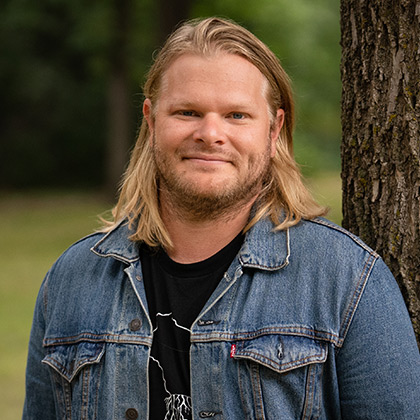
Josh Tarp is a multi-instrumentalist, singer-songwriter, and worship leader from Minneapolis with over 15 years of experience in church & worship leadership. Josh serves as the Director of Marketing at Motion Worship, helping to write various blog posts, managing social media, designing graphics, and handling customer service.